Pricing is the question almost every new designer avoids for too long. You can learn to read a floor plan in a week. Learning to say a number out loud to a client, without apologising for it, takes longer. The good news is that pricing is mostly a system, not a feeling, and once you have a system the nerves fade.
Here are the three common ways interior designers charge, what each one encourages, and how to set a first price you can defend.
Option one: hourly rates
Charging by the hour is the simplest model to understand. You track your time, multiply it by your rate and invoice. It feels safe, because you are paid for every hour you work.
The problem is what it rewards. If you get faster and better, you earn less for the same job. Clients also find hourly billing stressful, because they cannot predict the final cost, which makes them hesitate to ask questions or request changes. Hourly rates work best for small, open-ended jobs: a two-hour consultation, a shopping trip, an hour of advice on a paint colour.
Option two: a fixed fee per project
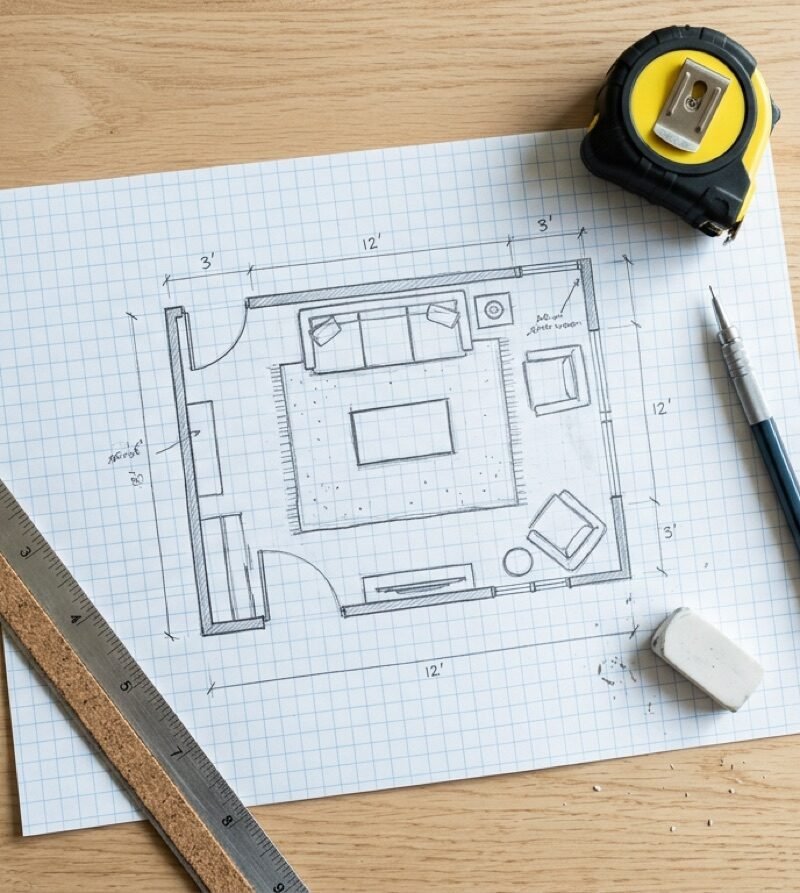
With a fixed fee, you agree a price for a defined piece of work: for example, a full design for one living room, including a layout, a mood board, a lighting plan and a shopping list. The client knows the cost up front. You benefit from working efficiently.
The risk is scope creep. If the brief is vague, one living room quietly becomes a living room, a hallway and “just a quick look” at the kitchen. The protection is a clear written scope that lists exactly what is included, how many rounds of changes are covered and what happens if the client wants more. Most experienced designers end up using some version of this model.
Option three: per square metre
Some designers, especially in larger renovation projects, charge a rate per square metre of the space. It scales naturally with the size of the job and is easy to quote quickly. The drawback is that size and effort do not always match. A small kitchen can take far more work than a large, simple bedroom. If you use this model, consider different rates for different room types.
How to find your starting number
Whatever model you choose, you need a base figure. Here is a straightforward way to calculate one.
- Decide what you need to earn in a year, before tax, to cover your living costs, savings and business expenses such as software, samples, insurance and travel.
- Estimate your billable hours. You will not bill forty hours a week. Marketing, admin, sourcing and learning take a large share of your time. Many self-employed designers bill somewhere between 15 and 25 hours a week.
- Divide one by the other. If you need 40,000 a year and can realistically bill 900 hours, your minimum rate is about 45 an hour. That is your floor, not your target.
- Check the local market. Look at what other designers in your area publish, and at what clients in your area are used to paying. You do not have to match them, but you should know where you sit.
Then use that hourly floor to build fixed fees. Estimate the hours a project will take, add a margin for the unexpected (twenty percent is common), and quote the total as a single price.
Charging for results, not hours
As you gain confidence, it helps to describe your fee in terms of what the client receives rather than how long it takes you. “A complete plan for your living room, ready to hand to a builder, with a shopping list for every item” is easier to say yes to than “about twenty-five hours of design time”. The work is the same. The conversation is completely different.
Common beginner mistakes
- Working for free to build a portfolio, for too long. One or two discounted projects can make sense. After that, a free project attracts clients who value free.
- Not putting the scope in writing. Even a one-page agreement prevents most disagreements.
- Forgetting revisions. Say how many rounds of changes are included, usually two, and what further changes cost.
- Taking the deposit too late. Ask for part of the fee, often 30 to 50 percent, before you start.
Your first price will not be perfect, and that is fine. Raise it a little with every few projects, keep notes on how long each job really took, and within a year your pricing will be based on evidence rather than nerves. If you are still building the work to show clients, start with our guide to building a portfolio before your first client.