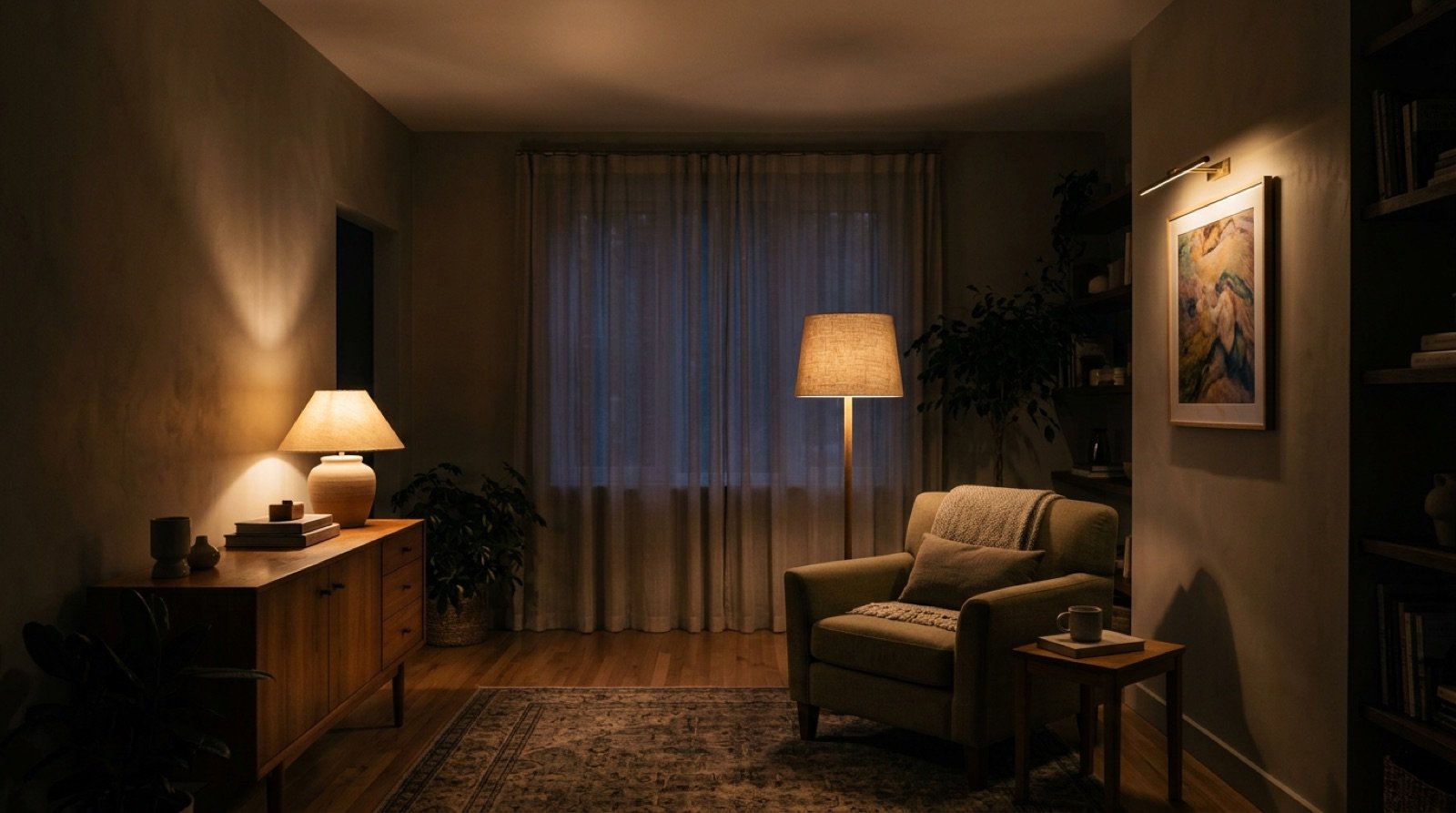
Walk into most homes in the evening and you will find a single bright light in the middle of the ceiling doing all the work. It lights the room evenly, flatly and without any atmosphere. Professional designers almost never rely on one light. They plan lighting in layers, and once you understand the three layers you will see why some rooms feel welcoming at night and others feel like an office.
Layer one: ambient light
Ambient light is the general light that lets you see and move around safely. It can come from ceiling lights, wall lights or even lamps bounced off a pale wall. The key is that it is soft and even, without harsh shadows.
Ceiling lights are useful, but they are best on a dimmer. At full brightness they suit cleaning or searching for lost keys. Dimmed, they can sit quietly in the background while the other layers set the mood.
Layer two: task light
Task light is focused light for doing something: reading, cooking, working, applying make-up. It should be brighter than the ambient light and placed close to where you need it.
- Reading: a floor lamp or a wall light beside or slightly behind the chair, with the light falling on the page, not in your eyes.
- Kitchen: under-cabinet lights over worktops, so you are not working in your own shadow.
- Desk: an adjustable lamp on the opposite side to your writing hand.
- Bathroom mirror: light from both sides of the face, rather than only from above, which casts shadows under the eyes.
Layer three: accent light
Accent light adds atmosphere and draws attention to something worth looking at: a painting, a bookshelf, a plant, a textured wall. It is the layer most homes are missing, and it makes the biggest difference to how a room feels in the evening.
Picture lights, small spotlights, lights inside shelves and even a simple lamp placed on a sideboard all count. Accent light creates pools of brightness and areas of shadow, and that contrast is what gives a room depth.
Light at different heights
A good rule of thumb is to have light sources at three heights: high (ceiling or wall lights), middle (table lamps) and low (a floor-level uplighter or a lamp on a low table). Light at several heights makes a room feel balanced and cosy, because the eye is not pulled only upwards.
Colour temperature and brightness
Bulbs are labelled with a colour temperature in kelvin. Warm white, around 2700K, suits living rooms and bedrooms. Around 3000K suits kitchens and bathrooms where you want slightly crisper light. Keep the same temperature within a room, because mixing warm and cool bulbs makes a space feel uneasy.
Brightness is measured in lumens. As a loose guide, a table lamp might use 400 to 800 lumens, a reading lamp 800 or more. Choose bulbs with a high colour rendering index (CRI 90 or above) if you can; colours, skin tones and materials look more natural under them.
Light also changes how paint and materials look, which we cover in reading the light in a room.
A simple plan for a living room
- Put the ceiling light on a dimmer, or replace it with something softer.
- Add a reading lamp next to each main seat.
- Place two or three table lamps around the room, in corners and on sideboards, so light is spread out.
- Add one accent light: a picture light, a lamp near a plant or a light on a bookshelf.
- In the evening, switch off the ceiling light and see how the room feels with only the lamps.
That last step is usually the moment people realise how much better a room can feel. The furniture has not changed. Only the light has.